Overheads and energy bills, two things that always seem to be going up.
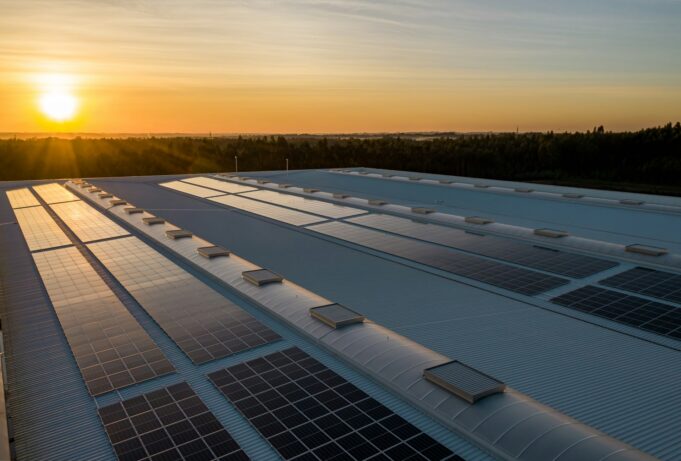
Except now, commercial businesses can cut energy bills and reduce overheads by turning wasted roof space into on-site power generation. From warehouses and production plants to office buildings and retail units, your business could be sitting under a potential clean energy gold mine.
By installing solar panels where the sun shines (and not much else happens), you can lower your business’s energy bills at no cost to your productivity.
Looking to reduce your dependence on external energy suppliers, create new money-making opportunities, and increase your property’s value? Here’s how on-site solar power can help.
Energy independence
This is one of the biggest advantages of installing on-site solar power generation: reduced reliance on the national grid.
Relying on external energy suppliers leaves a business vulnerable to energy price hikes and unpredictable costs. Over the last 5 years, energy prices for the average UK company have risen by a huge 68.4%. For businesses with high energy demands, this makes budgeting very tricky. On-site power generation can protect a business from dramatic rises in energy costs.
Power outages, although rare in the UK, are another thing to consider. How would your business cope with no electricity? Downtime can be expensive, but on-site power generation and battery storage provide you with a lifeline should the power shut off.
Simply put, with external energy providers, you just don’t know what’s going to happen. Producing your own energy means protecting your business’s freedom and fully owning your own energy strategy. On-site solar power generation literally puts the power in your hands.
Sustainability can lower running costs
Whether you’re looking towards solar power to save the world or just save you money, the beauty of on-site power generation is that it can do both.
Depending on your business’s roof space and orientation, local facility costs and weather, on-site solar power generation can reduce a businesses’s energy costs from anywhere up to 80%.
The UK also offers a huge range of tax benefits and support schemes to lower the cost of green-energy investments.
Full expensing: This allows qualifying companies to deduct the cost of solar installation from their taxable profit.
Annual Investment Allowance: An AIA can also help a business claim tax relief on the purchase of qualifying equipment, significantly reducing installation costs.
Increase your property’s value
Renewable energy generation is an asset. And if the time comes when you want to sell your facility, already having solar infrastructure in place can increase its property value.
Potential buyers, investors, and tenants can also be attracted to properties equipped with renewable energy systems, capable of lower operating costs, especially as the importance of environmental reporting continues to grow.
Energy savings over a number of years will pay back what you’ve invested in your facilities, typically within 3-7 years, after which, you will be left with a more energy-efficient property.
Sell power back to the grid
During some sunny spells and periods of lower energy consumption, panels may produce more energy than your business needs. Instead of letting it go to waste, you can make more money by selling it back to the grid.
The smart export guarantee (SEG) is a UK government-backed scheme that requires energy providers to pay back small businesses for the energy they export back to the grid.
While this scheme is only available for small businesses (with system capacities less than 5MW), larger businesses can find a way to benefit from excess energy too, with solar battery storage storing surplus electricity for later use.
What to look for in an installer
Picking the right installer is crucial to saving your business money. Start by looking for the appropriate industry recommendations and certifications.
Also, remember that reputable installers will be able to demonstrate compliance with recognised industry standards and will have probably worked on similar installations before. Check their reviews.
Customer service matters. Pick a friendly team that can explain the complexities to you without trying to baffle you with jargon or worse, give you the hard sell. If you feel you’re being pressured into a system that’s larger than you need, or things are explained to you in a deliberately confusing way, you might not be dealing with a good provider.
If you’re researching reputable solar companies in the UK, look for a provider with proven commercial experience, transparent advice, strong customer reviews, and a commitment to designing systems that match your organisation’s long-term energy goals.