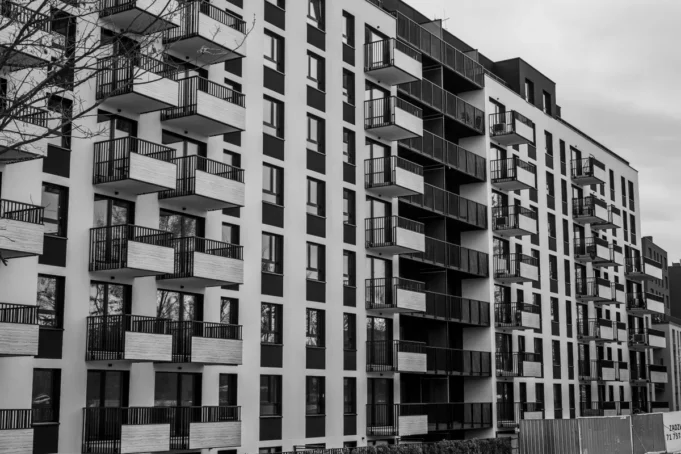
Bath & North East Somerset Council’s planning committee has unanimously approved Feilden Clegg Bradley Studios’ (FCBS) plans for the Bath Press site regeneration on Lower Bristol Road, consenting a mixed-use scheme that will deliver 600m² of commercial space alongside new residential development on a 1.1-hectare parcel of mainly vacant brownfield land.
The committee vote, taken on 2 September, clears the way for developer City & Country to press ahead with the western portion of a wider masterplan for the former printworks north-west of Bath city centre. According to Show House, City & Country’s residential-led scheme will see 250 new homes built on the site over the next four years, with BBC News reporting that work is expected to start in early to mid 2025.
Scheme layout and affordable housing provision
FCBS’s western parcel is arranged around a ground-level podium housing three commercial units, 16 flats, and 82 car park spaces, with a further 100 parking spots provided in a basement. Cycle and bin stores, plant rooms, and servicing areas are incorporated at ground level. Six blocks of flats, rising to six storeys at their highest, will sit above the podium, while five houses will be built in a terrace on the Brook Road car park portion of the site. Nine of the homes within the western parcel will be affordable.
Planning officers noted that, following an independently reviewed viability appraisal, the retention of 34 affordable homes across the scheme ‘receives significant weight as a benefit’. The Bath Preservation Trust had argued that the affordable housing provision was ‘not policy compliant’, and the council’s own economic development team flagged that the layout would result in the loss of more than 400m² of employment space. Officers acknowledged that the commercial and office space provision ran contrary to policy, but said this should be read in the context of ‘changed office market conditions’.
Bath Press site regeneration: heritage concerns and materials debate
Historic England registered formal ‘concerns’ over the application, stressing that the council needed to be satisfied that the scheme’s height and massing did not negatively affect ‘appreciation of the natural bowl in which Bath sits’. The heritage body also raised questions about the proposed biscuit-coloured brick cladding, noting that, while ‘very widely used in new housing developments in London and Cambridge’, it was ‘not a material that is native to Bath’. Historic England was explicit in its view that ‘the overwhelming dominance of Bath Stone as a cladding material in buildings in the city of all periods is a fundamental characteristic of the city and of the world heritage site’. The planning committee proceeded to approval regardless.
The heritage concerns speak directly to the embodied-carbon and local-material questions that have become central to sustainable design in sensitive urban contexts. Bath Stone is a locally quarried limestone, and the decision to use brick cladding instead has implications not only for townscape character but for supply-chain carbon, a consideration Historic England’s objection did not directly raise but which designers working in world heritage settings are increasingly expected to weigh.
A long-vacant site, and the eastern parcel already under construction
The Bath Press site has a prolonged history of inactivity. According to Premier Construction News, the site became vacant in 2007, with demolition of the former printworks structures then carried out between September 2017 and November 2018 to prepare the land for redevelopment. A separate scheme by Collado Collins Architects for the eastern side of the site received consent in 2016 and is currently under construction, meaning FCBS’s approval completes the planning picture for the wider Bath Press masterplan.
FCBS founding partner Keith Bradley described the committee’s decision as ‘an important step towards bringing this long-vacant brownfield site back into use and completing the regeneration of this important part of Bath with a place that feels connected, generous and built to last’. He added: ‘Good housing is about creating places where people can put down roots, where landscape and community are part of everyday life, and where development contributes positively to the wider city. As the first practice to win the Stirling Prize for a housing scheme, we understand the importance of responding to local context and the responsibility that comes with designing in a city of such architectural significance.’
City & Country design and planning director Simon Vernon-Harcourt said the practice was ‘especially pleased to have received unanimous support from the planning committee, who recognised the outstanding design quality, which will enable us to realise the wider vision for Bath Press’. He noted that Bath & North East Somerset Council’s planning team ‘were also proactive and positive through the process and really helped deliver this scheme and explain it eloquently to the planning committee’.
A timeline for completion of the FCBS western parcel has yet to be set out, though the expected early-to-mid 2025 site start gives the first firm programme marker for the Bath Press site regeneration.