Skirting boards rarely get much thought during a renovation, yet they end up touching almost every wall in a home. Get the colour and profile wrong and somehow it shows everywhere at once. Get it right — particularly with a white MDF skirting board — and nobody notices, which is sort of the point.
This combination has become close to a default in modern interiors. Not because it’s exciting, but because it solves a lot of problems at once: practical material, neutral colour, works with basically anything.
What it actually is
MDF — medium-density fibreboard — is wood fibres pressed together with resin under serious heat and pressure. The result is dense, smooth, and remarkably uniform compared to natural timber. No knots, no surprise grain patterns, nothing to work around.
“White,” in this context, usually means factory-primed and ready for painting, though some products arrive pre-finished. Either way, the final white surface typically comes from paint applied after installation — not baked in from the factory.
Put those two together — engineered consistency plus a neutral colour — and you get something that fits comfortably in both period homes and brand-new builds. Not bad for a material that’s basically compressed sawdust.
Why MDF won this fight
A few reasons MDF dominates interior mouldings now: uniform density (no knots, no irregularities), a smooth surface that takes paint beautifully, decent stability — less warping than a lot of natural woods — and it’s easy to machine into precise profiles. Oh, and it’s cheaper than most hardwood alternatives.
For big jobs — multiple rooms, entire properties — that consistency matters enormously. Nobody wants board twelve looking subtly different from board one.
What white actually does for a room
White isn’t just “safe,” though it gets dismissed that way sometimes. It reflects light. Creates contrast. Pairs with literally any wall colour or flooring you throw at it.
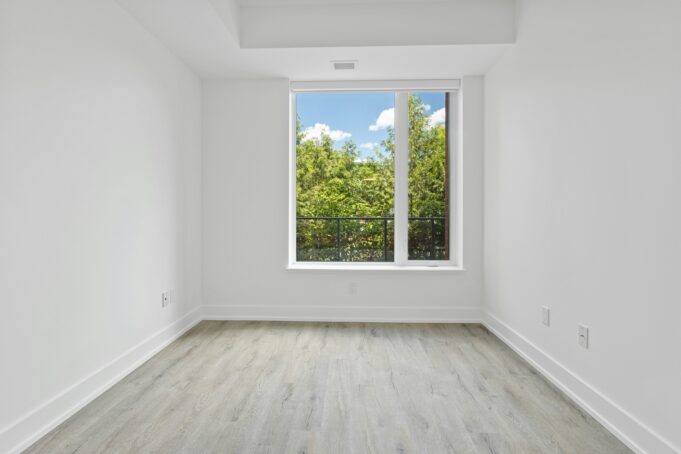
A white MDF skirting board frames a room — defines where wall ends and floor begins, cleanly. It highlights proportions (especially useful in older homes with generous ceiling heights). And against coloured or patterned walls, it provides genuine contrast without competing for attention.
That’s really the trick: white skirting rarely fights with anything else in the room. Furniture, flooring, wall colour — all of it gets to take priority, because the skirting just… frames things.
Profile options, briefly
Square edge — minimal, modern, clean lines. Works in contemporary spaces where simplicity is the goal.
Rounded or bullnose — softer transition, slightly less stark than square edge.
Decorative profiles — ogee, torus, stepped designs — generally suited to traditional or transitional interiors where more character is wanted.
Which one fits depends heavily on ceiling height, room size, and what era the property’s working with.
The practical side
Beyond looks, skirting does real work. It protects lower walls from scuffs — furniture, vacuum cleaners, general foot traffic — particularly in hallways and high-use rooms where walls take a beating.
Maintenance stays simple too. Damp cloth for routine cleaning, paint touch-ups for marks. And because it’s repaintable, a white MDF skirting board can be updated whenever room colours change — no replacement needed, just a fresh coat.
Where it’s not ideal
MDF has limits, worth knowing upfront.
Moisture is the main one. Standard MDF doesn’t cope well with prolonged damp — bathrooms, kitchens, utility rooms generally call for moisture-resistant variants specifically.
Impact resistance is decent but not exceptional — denting or chipping happens more readily than with some hardwoods in genuinely high-impact spots.
And the final look depends almost entirely on prep. Skip priming, rush the paint job, and imperfections show — sometimes immediately, sometimes a few months later once they’ve had time to bother you.
Getting installation right
Walls need to be clean, dry, and reasonably level first. Skip this and gaps appear later, affecting both how it looks and how it performs.
Cutting matters too — especially at corners, where mitre joints need careful alignment to keep the visual line continuous. A slightly-off mitre is one of those things that’s hard to ignore once you’ve spotted it.
Fixing methods vary — adhesive, nails, sometimes both — depending on wall type. After installation, joints and fixing points get filled, sanded, and painted. This final step is genuinely critical; it’s the difference between “professional finish” and “you can tell where the boards meet.”
Worth comparing before buying
Heights, thicknesses, profile shapes — all vary more than people expect across different products. For anyone planning a renovation, looking through white mdf skirting board options and comparing specs properly beforehand saves headaches, especially on larger projects where small mismatches multiply across dozens of lengths.
What’s trending
Taller profiles are gaining ground — stronger visual definition, better proportion in modern interiors.
White still dominates overall, but pairing white skirting with darker wall colours for contrast is showing up more in contemporary spaces.
And minimalist interiors increasingly favour flatter, simpler profiles — subtle over decorative, which suits white MDF’s understated character anyway.
Long-term value
Properly installed and maintained, white MDF skirting boards hold up well across a wide range of settings. The ability to repaint extends their useful life considerably — interiors change, skirting doesn’t necessarily need to.
It won’t offer the natural variation solid wood provides. But for consistency, cost, and ease of use across most residential and commercial projects, it’s hard to beat.
Bottom line
A white MDF skirting board isn’t a flashy choice, and that’s exactly the appeal — practical material, neutral colour, works almost everywhere. Get the profile and height right for the room, prep and install it properly, and it quietly does its job for years without asking for attention again.