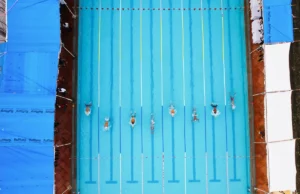
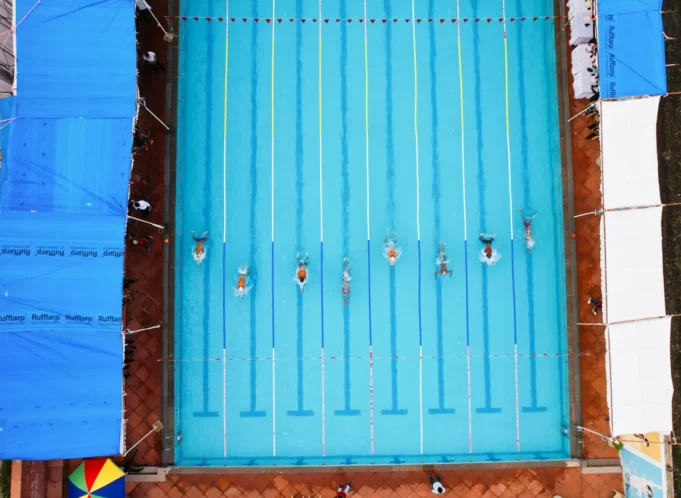
The Hwamyeong outdoor swimming pool competition is now open, with Busan Metropolitan City and the Design Council Busan inviting global design teams to reimagine an existing seasonal facility as a year-round, family-friendly water leisure complex integrated with the city’s broader waterfront space redevelopment project, according to Busan Metropolitan City.
The brief asks entrants to create synergy between the new facility and Busan’s ongoing waterfront regeneration ambitions, moving well beyond a simple pool upgrade. The site in question sits within Hwamyeong Ecological Park, a green corridor that buffers the city’s dense residential zones from the Nakdong River estuary, a wetland habitat of ecological sensitivity, as reported by World Archi Design Magazine. Any proposal will therefore need to reconcile active leisure infrastructure with the ecological constraints of that setting.
The dormant-facility problem driving the Hwamyeong outdoor swimming pool brief
The competition’s year-round remit addresses a well-documented problem with outdoor public swimming facilities in temperate climates. World Archi Design Magazine notes that such pools lie dormant for roughly nine months of the year, occupying valuable land while generating no revenue and little community engagement. In a city such as Busan, where waterfront land carries both commercial and civic pressure, a facility that functions only through the summer months represents a poor return on public investment and a missed opportunity for placemaking.
Framing the Hwamyeong brief around four-season programming is therefore not simply an amenity aspiration. It is a response to the land-use economics that make single-season outdoor pools increasingly difficult to justify. Designers will need to consider how the facility operates across the full annual calendar, which implies decisions about enclosure strategies, thermal performance, building fabric specification and the energy systems required to condition spaces that may need to transition between sheltered indoor conditions and open-air use depending on the season.
The ecological park setting adds a further layer of complexity. Hwamyeong Ecological Park’s role as a buffer between dense urban fabric and the Nakdong River estuary means that surface drainage, hard-standing footprint, and artificial lighting all carry potential consequences for the adjacent wetland habitat. Proposals that treat the waterfront context seriously will need to demonstrate considered approaches to water management and biodiversity, not merely a programmatic response to the leisure brief.
Competition programme and design submission deadlines
The competition runs in stages. According to Wettbewerbe Aktuell, the Stage 2 design submission deadline is 14 October 2026 at 18:00, with the announcement of the final awardee scheduled for 19 October 2026. The tight window between submission and decision reflects a procurement process structured for speed, placing emphasis on the clarity and completeness of the design package teams prepare for the final stage.
For practices considering entry, the ecological park location and the year-round programming requirement together set out a genuinely complex design problem. The outdoor pool as a typology is not new, but delivering a facility that performs across all four seasons, responds to a sensitive wetland edge, and generates the kind of waterfront animation Busan’s redevelopment project is seeking calls for thinking that goes well beyond standard leisure centre specification.
The Hwamyeong outdoor swimming pool competition sits within a wider pattern of Asian coastal cities investing in waterfront leisure infrastructure as a driver of urban regeneration and civic identity. Busan’s decision to anchor that ambition at an ecologically sensitive site, rather than on cleared brownfield land, raises the design stakes and gives the Hwamyeong brief a level of environmental seriousness that should reward entrants who engage with both the programme and the landscape in equal measure. The final awardee announcement is set for 19 October 2026.