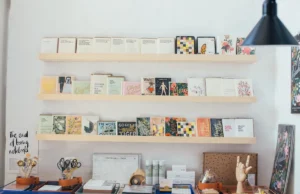

The Alexander Brodsky Pushkin House bookshop has completed on the ground floor of the Bloomsbury cultural centre, marking the first permanent built work in the United Kingdom by the artist-architect. Constructed in timber and incorporating vintage shelf units, antique cigar boxes and old display cabinets sourced from an antiques fair, the room-sized installation houses what is described as the only bookseller in the UK dedicated simultaneously to Russian and English literature, theory and histories.
Mirrors, sculpted heads and an endless library
Mirrored side panels and overhangs have been integrated into the shelving design to produce what Brodsky describes as ‘mirrors to eternity’. The reflections create the visual impression of an endless library, the central effect the Alexander Brodsky Pushkin House bookshop was conceived to deliver. Along the top of the bookshelves sit sculpted heads of celebrated British and Russian writers, including Shakespeare, Pushkin, Tolstoy and Robert Louis Stevenson. Brodsky has described the sculptures as ‘a nod to an old Russian tradition of placing portraits and busts of cultural figures in schools.’
The stock ranges from contemporary and historical works in translation from Ukraine, Belarus, Central Asia, the Caucasus and the Baltics, to children’s books and new prose and poetry alongside classics. The brief was, in Brodsky’s words, to make the space ‘as comfortable, welcoming, cosy and not boring as possible’, combining newly designed joinery with found antiques to ‘preserve the atmosphere of an old house.’
Brodsky is a key member of the Moscow Conceptualists, known initially for his ‘paper architecture’ in the 1970s: intricate, fantastical architectural etchings that circulated outside official Soviet channels. More recent work has extended to larger installations incorporating clay architectural models, façades and full-size pavilion structures, often built from found materials such as old timbers and window frames. According to The Moscow Times, his portfolio also includes the Joseph Brodsky museum in St. Petersburg, a project that places him within a sustained practice of culturally charged interiors and memorial spaces.
A Grade II*-listed shell, restored and opened up
Pushkin House occupies a Grade II*-listed 18th-century building in Bloomsbury, designed by Henry Flitcroft. The Alexander Brodsky Pushkin House bookshop sits within 48m² of gross internal floor area on the ground floor, with the hallway accounting for a further 26m², bringing the total ground-floor intervention to 74m². As part of the project, later partitions have been removed to reveal a fine 1740s sandstone and marble floor, the condition of which pointed to the need for specialist stone restoration. The listing status of the building is recognised by Historic England, which grades such structures as being of more than special interest.
Brodsky worked alongside Fishdream Productions on the design and installation of the shelving, with historic conservators DBR responsible for the stone floor restoration. The form of contract was JCT minor works, with EC1 Build as main contractor. Richard Hurst served as structural engineer, BWA as quantity surveyor, and Harwood Building Control as approved building inspector. Joinery was carried out by Alterd. Start on site was February 2026, with a completion date of July 2026.
The bookshop opened at the end of September. Elena Sudakova, director of Pushkin House, and Patrick Duerden, trustee of Pushkin House, are listed respectively as curator and lead architectural adviser on the project.
Further phases planned across the building
Brodsky has expressed a clear intention to develop the project beyond the ground floor. His stated hope is to continue working with Pushkin House into the basement and upper floors, with proposals including a film and lecture auditorium, a new vodka bar at basement level, an adaptable exhibition space and what he describes as ‘Pushkin’s imaginary bedroom’ on the upper floor to accommodate artists in residence. The programme would, in Brodsky’s framing, create ‘a home for Pushkin and others in London.’
Whether those further phases proceed, the ground-floor completion already represents a layered act of conservation and cultural programming within a listed shell: a 1740s floor uncovered, later accretions stripped back, and a bookshop stocking literature in exile from across the former Soviet sphere installed in its place. The project data lists start on site as February 2026 and completion as July 2026, with the Alexander Brodsky Pushkin House bookshop having opened its doors to the public at the end of September.