Adrian Gale, the Adrian Gale architecture professor whose career spanned the postwar Modernist generation and decades of architectural education at Plymouth, has died aged 95, according to the Architects’ Journal. Born in 1931 and active well into his later years, Gale remained, until the end, a figure whose influence was transmitted less through built work than through the people and cultures he shaped around him.
From the Architectural Association to Mies van der Rohe
Gale emerged from the Architectural Association in the 1950s as part of a cohort that included Kenneth Frampton, Neave Brown, Patrick Hodgkinson, John Miller and David Gray. His architectural education coincided with a pivotal period when the heroic phase of European Modernism was giving way to something more complicated: the work of Le Corbusier, Aalto and the Smithsons was being contested alongside the increasingly influential output arriving from America.
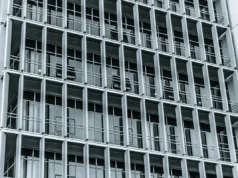
For Gale, America offered the possibility of encountering the Modern Movement at first hand. That conviction took him to the United States, where in the 1950s he worked with John Winter in San Francisco and subsequently encountered the work of Ludwig Mies van der Rohe in Chicago. His association with Mies became one of the defining influences of his career. Gale was not simply interested in Mies as an historical figure: he absorbed the discipline of his architecture, its structural clarity, precision and restraint, and its insistence that construction itself could become architecture.
His time in America gave Gale an unusually direct relationship with the American interpretation of European Modernism. It also reinforced a characteristic of his personality: an impatience with architectural fashion and a determination to understand buildings through their making. On returning to Britain, he became associated with the progressive London practice of Douglas Stephen & Partners, an environment in which practice, criticism and architectural ideas were unusually closely connected.
His relationship with the architect and landscape designer Georgie Wolton (1934-2021) was another important strand of this period. Wolton had herself been closely associated with the Modern Movement, and the two were professionally and personally connected within the architectural culture of the time.
The Plymouth years and the Adrian Gale architecture professor legacy
It was at Plymouth where the Adrian Gale architecture professor legacy took its most enduring form. Gale breathed new life into the School of Architecture there, very quickly establishing a reputation for quality that led to the school becoming known as ‘The White School of the West’. Under his influence, Plymouth became a place where architectural education was energetic, outward-looking and unusually well connected to the wider architectural world.
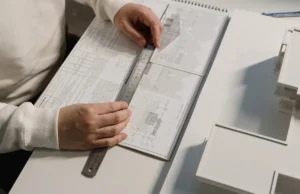
His approach to education was not shaped by dogma or formal pedagogy. Rather, it was formed through association with practice, by example, and by the lessons drawn from being at the centre of the Modernist adventure. He preferred the studio and the workshop to the lecture theatre. Designing was encouraged as an iterative process, developed through drawing and model-making. Ideas were not to be merely discussed: they were to be made visible, tested, altered and tested again.
Gale possessed qualities that his former colleague Alan Phillips, founder of Alan Phillips Architects, identified as those of a natural educator: intellectual curiosity, generosity towards younger architects and a willingness to question established orthodoxies. His understanding of Mies was particularly valuable because it was experiential rather than academic. Having worked in Mies’s office, he could discuss the architecture from the inside, as an architecture of structure, proportion, detail and discipline, rather than as a collection of formal images.
He promoted study tours, exchanges, winter schools and competitions as part of a consistent drive for diversity and inclusion. Architects, teachers, students and institutions were drawn into a network that extended far beyond Plymouth. The result was more than a successful school: Gale created an architectural culture in which curiosity was valued above certainty and conversation above doctrine.
Criticism, writing and later institutional work
Gale was also an active critic and writer. His writing was characterised by the same mixture of architectural knowledge and scepticism that informed his teaching. He could be sharply critical of buildings he regarded as superficial, while remaining alert to genuine innovation. Later in his career, he became associated with the Prince’s Foundation for Architecture and the Urban Environment, continuing his interest in the relationship between architecture, urbanism and the wider public realm.
Throughout, his fundamental questions remained constant. What makes a building architectural? How does structure become form? What is the relationship between building and landscape? These were not rhetorical positions but live enquiries, kept open and argued through decades of teaching, writing and conversation.
Gale belonged to a generation that believed modern architecture still had unfinished business. Yet he was never simply a doctrinaire modernist. His real contribution was to keep the questions alive and to make others want to participate in answering them. As Phillips wrote: architects leave buildings; teachers leave people. Adrian Gale left both.