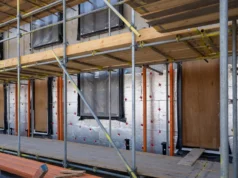
The first time I stood at the edge of a timber‑framed construction site outside Edinburgh last spring, I was struck not by the smell of fresh sawdust or the orderly queues of burgundy‑clad workers, but by how different it felt from the usual urban grit: lighter, almost brittle‑quiet, as if the whole structure were breathing with trees still rooted somewhere deep in the soil.
Over the last few years in Britain, that sensation — a sense that buildings can carry more than weight — has crept into architectural dialogues, policy white papers and even casual dinner conversations among people not otherwise interested in civil engineering. The idea now taking shape and substance is that timber, particularly engineered products like cross‑laminated timber (CLT) and other forms of mass timber, isn’t just another material; it’s a pivot in how we think about carbon and construction.
It began, quietly, with numbers that startled industry analysts: every cubic metre of wood incorporated into a building effectively stores roughly a tonne of carbon dioxide that would otherwise be free in the atmosphere. In contrast to steel and concrete — whose production belches greenhouse gases during mining and processing — timber sequesters what it once absorbed, locking it away for decades or longer.
That’s the promise anyway, and once you understand it, you start to see why policymakers are pushing it. The UK government’s Timber in Construction Roadmap 2025 sets out to expand safe timber use in homes, schools and public buildings, part of a strategy to trim the built environment’s share — roughly a quarter of total national greenhouse gas emissions — on the road to net zero. The roadmap doesn’t feel like hyperbole; it’s a carefully drafted acknowledgement that how we build matters as much as what we build.
Architects speak in more visceral terms. A Scottish designer I met last autumn described CLT not only as beautiful in exposed interiors, but situationally brave: “It invites people to reconsider what permanence means.” True enough. Early timber homes across the UK were often quaint, cottage‑like affairs. Now there are mid‑rise buildings, experimental offices, and community halls rising with wooden frames engineered to modern safety and fire standards.
Despite this, the story isn’t straightforward. Nearly 80 % of the timber used in UK construction still comes from overseas, adding transportation carbon to the equation and complicating the clean narrative of local wood absorbing carbon. Yet there are pilots and suppliers — modular factories outside Oxfordshire among them — where robotics and timber are converging to make prefabrication faster, cheaper and even more carbon‑efficient than masonry alternatives.
And the benefits are measurable. Recent studies in the UK suggest that choosing engineered timber over concrete can cut embodied carbon by large margins — as much as 60 % on some projects — and that the whole carbon profile of a timber building can be lower even after accounting for manufacturing and transport.
The practical tension, though, is always just below the headlines. Engineers still debate moisture management, fire safety and the long‑term durability of wooden structures in a damp climate. Residents in one new CLT‑framed housing development told me they adore the warmth of the wood and its indoor air quality, yet they also admit to a flicker of worry when autumn storms hit and the wind howls among roof trusses. That sense of unease — admiration on one hand, uncertainty on the other — is part of the human terrain here.
I remember one architect saying to me, half in jest, that when she visits another CLT project, she checks the pulse of a beam, as if it might still be alive — lumber with a heartbeat.
That mix of science and sentiment is precisely why timber’s carbon story resonates: it is rooted in forests, but its implications run through policy, finance, community wellbeing and the very texture of everyday life.
It doesn’t hurt that timber construction can also reduce waste. Off‑site manufacturing cuts down on material spillage and site noise, and in some cases supports circular design practices where panels can be disassembled and reused. However, always in these conversations there’s a cautionary voice reminding us that timber isn’t a panacea — it’s one lever among many in decarbonising the built world. Cement and steel have their roles, just as carbon reduction strategies must be multifaceted.
There’s a subtle irony, too. As cities across the UK seek to embrace timber’s low‑carbon promise, they are simultaneously greening their trees and woods, expanding canopy cover not just for beauty but as part of the carbon sink strategy itself. It’s a full circle: forests feed buildings which store carbon that forests originally absorbed.
Walking through a timber frame that evening in Edinburgh — the smell of wood lingering in my coat — I couldn’t help but think how odd it was that an ancient material, so elemental in human history, might hold one of the better cards in the fight against climate change. There was a quiet comfort in that observation, even as the industry works out the kinks.
What emerges from all of this isn’t a single answer but a shift: timber construction challenges the assumption that progress must be heavy, grey and carbon‑intensive. Instead it asks a provocative question: can our buildings be lighter not just in weight but in impact, rooted in forests that themselves must be renewed and protected?
That question, and the choices it propels, feels like a defining conversation of our time.