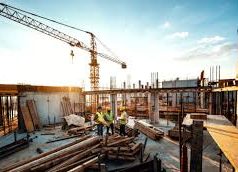
I remember standing on a muddy site on the outskirts of Bristol back in late 2023, watching tower cranes trace lazy arcs against an overcast November sky while a young architect sketched sections of a proposed apartment block. She wasn’t talking about steel loads or floorplans anymore. She was talking about carbon — not the invisible fumes you can’t see, but the hidden tally locked into every tonne of cement and every beam of steel they planned to use. That shift, from design as architecture to design as carbon calculus, feels like one of the subtle but unmistakable inflection points in UK construction.
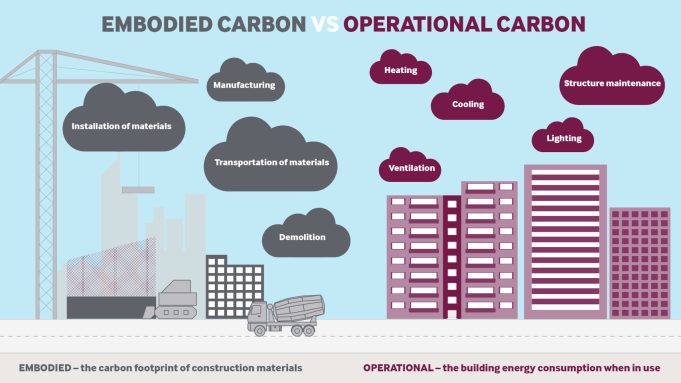
For decades, the industry’s carbon fixation was on operational emissions — the gas boilers, the lighting, the heat pumps working away once buildings were occupied. Embodied carbon was a whisper in the background, a detail tucked into lifecycle assessments that few outside sustainability circles bothered with. But as the UK grid greened and energy efficiency standards pulled down operational figures, the other half of the ledger began to loom large. The emissions associated with extracting raw materials, forging them into usable products, trucking them across the country, and finally erecting them on site are as real as the bricks themselves — and they are being “locked in” long before a building is ever occupied.
A recent briefing from the UK Green Building Council underscores how this subtlety has become unavoidable: embodied carbon already contributes tens of millions of tonnes of CO₂ annually and, as operational emissions fall, could represent more than half of the built environment’s footprint by 2035. On paper, those numbers are abstract; on site, they translate into real decisions about which materials to order, which suppliers to trust, and how a structure is conceived in the first place. Once a concrete slab is poured or a steel frame is bolted together, that carbon can’t be taken back.
On a rainy afternoon in Leeds last spring, I toured a warehouse being retrofitted for mixed use. The project manager pointed out how they had deliberately kept large swaths of the original structure, even where it meant more complicated work. “That old steel,” he said, tapping the beam above my head, “is worth more than gold in our carbon budget.” Reuse, he explained, can slash embodied emissions because manufacturing new steel can be orders of magnitude more carbon intensive than reclaiming and repurposing existing material.
And yet, for all the talk of carbon footprints and climate targets, embodied carbon remains largely unregulated in the UK. Contrary to the growing stringency around operational performance, there’s no statutory baseline that builders must meet for the material-related emissions baked into a project. It’s left to voluntary commitments, client demands, and pockets of innovation within the industry. The result is an uneven patchwork: trailblazing architecture firms and contractors tout low-carbon strategies, while others proceed with business as usual, largely oblivious or indifferent to the hidden cost of their choices.
The choice of materials is where the conversation gets most granular, and most contested. Steel, concrete and cement — the staples of modern construction — are notorious for their carbon intensity. Cement production alone accounts for a significant slice of global emissions; in the UK context, it shows up starkly when you break down the embodied carbon of a building’s shell. Timber and other bio-based materials often get cast as the green alternative, not least because trees sequester carbon as they grow. But it isn’t a simple story of wood equals good and concrete equals bad. As one sustainability consultant in Bath told me, “Timber has its own set of challenges — sourcing it responsibly, ensuring durability, balancing fire safety — but when you get it right, the carbon accounting tilts.” What she meant was manifest in the design team’s spreadsheets: a building conceived with cross-laminated timber can lock carbon into its very structure, reducing net embodied emissions compared with an all-steel frame.
I remember that moment of realization — it wasn’t revolutionary, just quietly startling — when I pored over a comparison of embodied figures for concrete versus engineered timber. The numbers didn’t lie: material choices could swing a project’s carbon footprint dramatically before a single brick was laid.
But material choice is only part of the picture. The broader construction process — from how far materials travel to how efficiently cranes and mixers operate — also matters. Prefabrication and off-site construction, for example, are gaining traction because they can reduce waste and streamline logistics, shaving carbon off the overall tally. Even demolition decisions now carry moral and environmental weight. A heritage building might be structurally obsolete, yet tearing it down and building anew dumps new emissions into the atmosphere that could have been avoided through adaptive reuse.
There’s also a social dimension. Architects and engineers who champion low-embodied-carbon design often find themselves having difficult conversations with clients about upfront costs versus long-term climate impact. One contractor in Manchester told me that clients are more comfortable paying for solar panels that reduce monthly energy bills than for sourcing low-carbon steel that shrinks an invisible carbon footprint. It’s a disconnect born not of ignorance but of incentives: operational savings are tangible, easy to quantify; embodied carbon savings are diffuse, technical, and often only visible to specialists.
What emerges from all this is a quiet revolution — not one announced with fanfare but unfolding in design meetings, cost estimations, and material specs across the country. There’s a slowly growing consensus that true sustainability in construction demands a holistic view of carbon, one that doesn’t privilege what happens after a building is finished at the expense of what happens before.
Yet unequal regulation and uneven industry uptake mean that for every project pushing boundaries, there are others still blind to the implications of their material choices. That disparity isn’t just technical; it reflects deeper questions about what we value in the built environment — durability over disposability, stewardship over short-term gain, and, ultimately, a willingness to count what has always been overlooked.