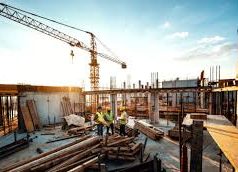
On a cold morning years ago, standing near a half-finished office block in the Midlands, I watched lorries idle in a queue, engines humming as steel beams were lifted into place. The site manager was proud of the energy model pinned to his clipboard. The building would be efficient, airtight, and cheap to run. Nobody mentioned the carbon cost of what was already locked into the concrete beneath our feet.
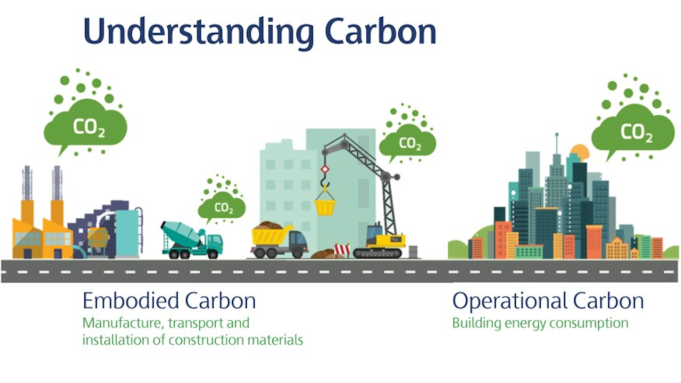
For decades, operational carbon dominated the conversation. It made sense. You could feel it. Boilers fired up, lights stayed on late, air-conditioning ran when windows could have been opened. Energy bills arrived every quarter, tangible and irritating. In the UK, building regulations steadily tightened, pushing down emissions from use, and by the late 2010s many new commercial buildings were performing far better than their predecessors. Some even boasted near-zero operational emissions on paper.
Yet something awkward happened as those graphs improved. The remaining carbon footprint of buildings refused to disappear. Instead, it shifted earlier in the timeline, into factories, quarries, and supply chains far from the finished façade. Embodied carbon, once treated as an abstract accounting exercise, began to look uncomfortably large.
Embodied carbon is quieter than operational carbon. You cannot switch it off with a control panel or shave it down with a behavioural nudge. It arrives all at once, front-loaded, emitted before the first tenant moves in. Cement kilns, steel furnaces, brickworks, shipping routes. Each decision taken during design fixes a portion of emissions that cannot be undone without demolition.
I remember the first time I saw a whole-life carbon chart where embodied emissions exceeded operational ones over a 60-year lifespan, and it made me pause longer than I expected.
In UK housing, this imbalance is becoming common. As gas boilers are phased out and electricity grids decarbonise, the carbon associated with running a building falls year by year. Meanwhile, the emissions embedded in materials remain stubbornly high. Concrete and steel alone account for a significant share, and their chemistry leaves little room for easy fixes. Even when efficiencies improve, the basic process still emits carbon.
Operational carbon, by contrast, has always been about habits as much as hardware. The caretaker who sets timers too generously. The office worker who opens a window while the heating runs. The landlord who delays a retrofit because tenants complain about disruption. These are human problems, messy but adjustable. Over time, UK policy has learned to manage them with incentives, standards, and nudges.
Embodied carbon resists that approach. Once the building is complete, the emissions have already happened. That finality is what makes it unsettling. It asks designers and developers to think less like operators and more like historians, weighing decisions today against impacts that will be felt, invisibly, across decades.
There was a turning point around the early 2020s when this distinction stopped being academic. Planning authorities in London and other cities began asking for lifecycle carbon assessments. Developers grumbled at first, seeing it as another spreadsheet to satisfy. But slowly, the numbers forced conversations that energy models never had. Do we really need a basement car park? Can we reuse the existing structure? Is a heavier façade worth the aesthetic payoff?
Embodied versus operational carbon is not a competition, though it is sometimes framed that way. A building with low embodied carbon but dreadful energy performance merely defers its damage. One with excellent operational efficiency but excessive material use spends its carbon budget too early. Lifecycle carbon thinking insists on balance, and balance is rarely comfortable.
In practice, this has changed design rooms in subtle ways. Timber is discussed with new seriousness, not as a stylistic flourish but as a structural choice. Retrofit gains prestige over demolition, even when the old building is awkward or unfashionable. Engineers argue for thinner slabs and simpler forms, not out of austerity but arithmetic.
Operational carbon still matters deeply, particularly for existing buildings that will be standing long after 2050. The UK’s ageing housing stock leaks heat and money, and decarbonising its use phase remains urgent. But for new construction, the operational gains are no longer enough on their own. The easy wins have largely been taken.
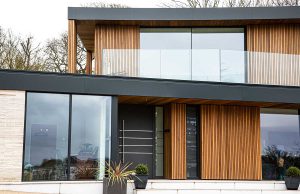
What unsettles some in the industry is that embodied carbon exposes taste and habit. Glass-heavy towers, deep floor plates, lavish finishes. These choices have long been justified by market demand or architectural language. Now they come with a measurable carbon price tag, one that cannot be offset by a few extra solar panels on the roof.
I once spoke to an architect who admitted, quietly, that whole-life carbon calculations had made him feel older, as if every drawing carried a memory of future regret.
The UK’s push toward lifecycle carbon assessment has not been perfectly coordinated. Guidance varies. Enforcement is uneven. But the direction is clear. Buildings are no longer judged only by how they perform once occupied, but by the full arc of their existence. That arc includes extraction, manufacture, maintenance, and eventual dismantling, whether we like to picture it or not.
Embodied carbon forces earlier responsibility. Operational carbon allows for later correction. That simple difference explains much of the tension between them. One is forgiving. The other is not.
As more projects publish their whole-life figures, a cultural shift is underway. Carbon becomes a design constraint, like budget or daylight, rather than an afterthought. Conversations grow more honest. Trade-offs are named rather than disguised. In those moments, the distinction between embodied and operational carbon stops being technical and starts being ethical.
Standing again on construction sites today, I still hear pride in low energy targets. But I also hear new questions, asked more softly, about materials already ordered and choices already made. The unease is real. So is the progress.
Lifecycle carbon in the UK has become a lens, not a slogan. It reveals where emissions hide, when they occur, and who is responsible for them. Embodied and operational carbon are simply two chapters in the same story, and the story, once seen whole, is harder to ignore.