
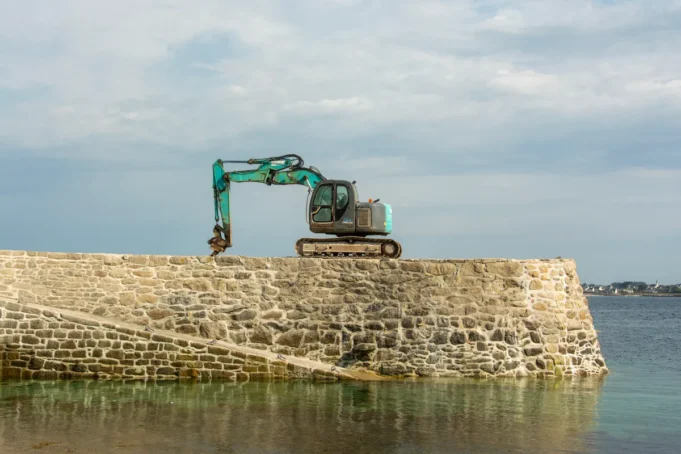
Montrose Port Authority has launched a formal procurement for its £35m Montrose Port quay construction scheme, seeking a design-and-build contractor to deliver three new berths alongside associated hardstanding, utilities and dredging works.
The Scottish port authority confirmed it is pursuing berths nine, 10 and 11, with the successful contractor responsible for developing and completing the design before constructing the quay structure and hardstanding areas. Quay furniture and associated services will also form part of the scope.
Procurement structure and contract terms
The contract will be placed under an NEC4 Engineering and Construction Contract Option A, using a priced contract with an activity schedule. Montrose Port Authority stated that the contractor must design and construct the works in accordance with its employer’s requirements and other contract documents.
The procurement is being run as a restricted procedure, with four contractors expected to be invited to tender. Bids will be assessed on a 70/30 split: 70 per cent weighted on cost and 30 per cent on quality. According to The Construction Index, variants will not be accepted for this contract, and options are similarly unavailable, meaning tenderers must price and submit strictly within the defined scope and terms. That constraint, combined with the activity-schedule pricing approach under Option A, gives the port authority a high degree of cost certainty before a spade enters the ground.
Interested firms have until noon on 16 October 2026 to submit requests to participate. Invitations to tender are then expected to be issued on 20 November, with construction scheduled to start on 31 August 2027 and reach completion on 31 August 2029.
Montrose Port quay construction in context
The Montrose Port quay construction programme represents a substantial capital commitment for the port authority, expanding its quayside capacity at a facility that sits on Scotland’s east coast. The dredging element of the scope is particularly consequential: extending navigable depth alongside new berths allows the port to accommodate vessels it cannot currently handle, which bears directly on the range of cargo and maritime operations that can be based there.
Hardstanding provision alongside the new berths is equally consequential for operational flexibility. Whether the expanded quay ultimately serves offshore energy logistics, bulk cargo, or other marine sectors, the quality and load-bearing specification of the hardstanding will determine what plant and equipment can be deployed at the new berths. The design-and-build route places responsibility for resolving those interdependencies squarely with the contractor, within the framework set by the employer’s requirements.
From a procurement discipline perspective, the 70/30 cost-quality weighting is a considered balance for a scheme of this scale. A pure cost competition would carry design risk for a client asking its contractor to develop the full technical solution; retaining 30 per cent for quality gives the assessment panel scope to differentiate on technical approach, programme management and supply chain depth, all of which carry embodied-carbon implications as much as cost ones. The prohibition on variants removes the complexity of evaluating alternative technical solutions and keeps the comparison between the four shortlisted firms as like-for-like as the design-and-build route permits.
The timeline running to August 2029 gives the selected contractor roughly two years on site, a window that will require close attention to material procurement lead times and sequencing of dredging alongside marine construction. Firms wishing to be considered must register their interest via Splash247‘s coverage notes the tender was published through the UK’s Find a Tender service, with the noon deadline of 16 October 2026 standing as the hard cut-off for participation requests.