Planning consent for the London Lighthouse Church extension was granted by Camden’s Planning Committee on 17 September, with members voting seven to three in favour of a scheme by Reed Watts that will take the existing single-storey building to three storeys, expand congregation capacity to 250, and target net zero in operation through a ground-source heat pump system replacing the existing gas-based installation.
The approved proposals involve a new simplified façade, a café and reception area at ground-floor level, and new flexible workspaces alongside a recording studio on the first floor. Reed Watts describe the approach as a ‘delicate blend’ of retention, refurbishment and extension, delivered on a challenging budget, in response to the site’s ‘need to evolve’.
A site with a complicated history
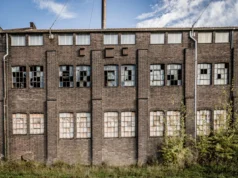
London Lighthouse Church occupies a plot with a layered past. A Victorian church dating to 1871 once stood on the land, but was demolished in 1964 when the site was broken up and the current, smaller building replaced it. The new Reed Watts scheme is itself the second attempt to bring the building up to the congregation’s ambitions: a previous application designed by Haworth Tompkins, which sought to convert the building into a multi-use facility for worship and community events, received planning consent but was ultimately abandoned. According to Church Times, Camden Council granted that earlier planning permission in October 2017.
The stalled Haworth Tompkins scheme left the congregation navigating what Jim Reed, director at Reed Watts, described as ‘years in the planning wilderness.’ Reed said: ‘Lighthouse London have demonstrated admirable determination and perseverance to get to this point.’ The current application has itself seen the design shift considerably over its life, responding to ‘evolving requirements from the church, its neighbours, the planners and, of course, the many technical constraints associated with city-centre development and retrofit.’
Reed added: ‘As a practice we tend to gravitate towards the challenge of complicated sites and complex briefs and this has been no exception. The journey has not been straightforward.’
London Lighthouse Church extension: sustainability and longer-term plans
On the environmental performance side, the approved scheme targets net zero operational carbon, with ground-source heat pumps replacing the gas-based heating system. For a congregational building operating with variable occupancy patterns and high ventilation demands, the switch from gas to a ground-source system represents a meaningful shift in operational carbon profile, though the scheme’s embodied carbon position was not detailed in the application materials released.
The approved three-storey extension bringing capacity to 250 is not, however, the church’s ultimate vision for the site. Reporting by the Camden New Journal indicates the congregation has explored proposals for a new six-storey building on the site that would provide a 450-seat capacity, framed as a Christian community centre on Finchley Road. The now-approved Reed Watts scheme, at roughly half that scale, represents a more incremental step forward, though Reed expressed hope that ‘momentum can be maintained so that the church’s ambitious plans for their community can be realised.’
Objections and the planning committee’s decision
The application did not pass without challenge. Residents of neighbouring flats raised two principal concerns at the planning committee meeting: noise nuisance from music played at the church, and loss of privacy resulting from the upward extension creating sightlines into adjacent dwellings.
On noise, the planning officer noted that the issues raised were a feature of the existing church and therefore could not be treated as material to the new proposals. An environmental noise survey had been submitted and was approved by the council. On privacy, the officer said sufficient measures had been incorporated to prevent angled views into the adjoining apartment block, and that access to the roof would be controlled. Satisfied by those responses, the committee approved the application seven to three.
Reed said the approval, after such a protracted process, puts the congregation in a position to move forward: ‘We now hope momentum can be maintained so that the church’s ambitious plans for their community can be realised.’ Construction is the next stage following the committee’s decision.