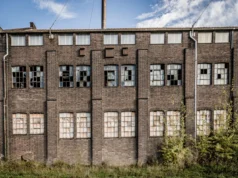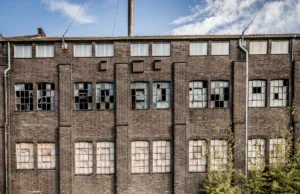
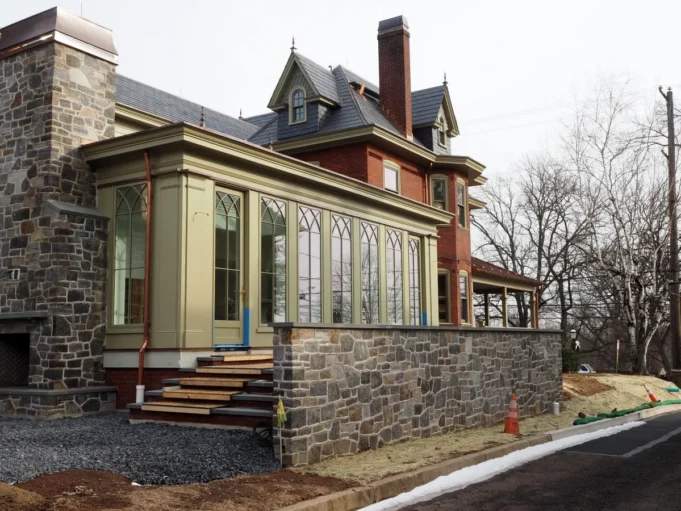
Assemble has secured a 25-year lease on Bromley Hall in Bromley-by-Bow as the basis for the Assemble Bromley Hall studio project, which the practice describes as its ‘most ambitious workspace project to date’, a scheme that will turn one of London’s oldest surviving brick buildings into bookable creative workspace and publicly accessible civic infrastructure.
The hall is thought to be approximately 561 years old, placing its origins in the mid-fifteenth century. Assemble’s lease includes a right-to-buy option, which the practice says is intended to provide stable, long-term rental agreements for future tenants as the site is progressively transformed.
A phased retrofit strategy for a medieval structure
Rather than undertake a wholesale conversion immediately, Assemble is establishing its own studio in the building first, framing that occupation as a ‘proof of concept’ for the wider civic vision it intends to realise over time. The approach is a considered one: the practice will work in residence, testing the building’s capacity before offering purpose-built studios to other occupants.
The physical works are substantial. A rear extension will increase the available workspace, a new link building will be added, and temporary structures currently on site, including RedBox storage containers, will be removed. The project also encompasses the neighbouring Grade II-listed Old Polar Library, which Assemble envisages restoring in the long term. The Historic England designation means any intervention will need to navigate the constraints that apply to listed structures, making the phased, occupation-first strategy a pragmatic as well as a philosophical choice.
The ground-floor Blount Room will be opened to the community, with capacity for up to 30 people. It will serve as a central meeting space bookable by both studio holders and members of the public, with affordable rates set aside for non-commercial uses. Assemble describes the overall ambition as creating ‘civic infrastructure’, with the building functioning as a ‘cultural resource’ alongside a public programme of cultural, educational and civic events.
Assemble Bromley Hall studio and the practice’s wider community track record
The project sits within a longer body of work in which Assemble has consistently linked the adaptation of existing buildings to community access and local creative economies. The practice won the Turner Prize in 2015 for its adaptation of two Victorian terraced houses into a community meeting place known as Granby Winter Garden. In 2014, it built out the Blackhorse Workshop CIC for the local community in Walthamstow. Over the past 15 years, Assemble has operated out of five spaces across London, including a studio within Leaside Yard in Bromley-by-Bow, where the practice is currently based.
That accumulated experience of occupying and programming workspace for others informs how Assemble has characterised its approach. The practice has described its workspace schemes as welcoming ‘different, welcoming loud, messy, and experimental practices eager to contribute to a creative and social ecosystem’, a formulation that positions the Bromley Hall project as a continuation rather than a departure.
Assemble partner Mathew Leung set out the long-term ambition directly: ‘We’re excited about the prospect of putting down roots in the local area, working in residence and being the long-term stewards of the site. We’re looking forward to creating and managing a unique creative workspace with a critical mass of makers which can support sustained public access to heritage and programming on site.’
To fund the eventual purchase of the site, the practice is launching a fundraising campaign. Once the capital is secured, the full programme of retrofit works (the extension, the link building, the removal of the temporary structures) can proceed. The right-to-buy option built into the 25-year lease means that long-term stewardship, rather than a fixed-term tenancy, remains the intended destination.