
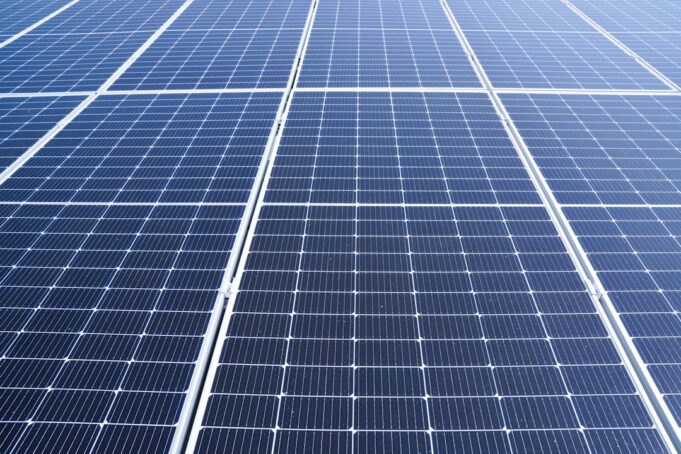
Solar panels are rightly specified for use in net zero carbon building projects, yet most designers are only aware of the narrow operational carbon savings of panels without any inkling of the bigger picture.
Understanding solar’s whole life carbon performance, from manufacturing through to decades of clean generation will help make more informed specification decisions for those genuinely pursuing sustainable, low carbon homes.
Embodied Carbon in Solar Systems
Embodied carbon covers emissions from panel manufacturing, transport, and installation. For monocrystalline silicon panels, the most common residential technology, this sits in the range of around 400 to 800 kgCO₂e per kilowatt-peak (kWp) of installed capacity, depending heavily on manufacturing origin. Panels produced in EU facilities typically range from 480 to 580 kgCO₂e/kWp, while those from fossil-fuel-heavy manufacturing grids can reach 800 kgCO₂e/kWp or more. The Global Electronics Council sets the threshold for its “Low Carbon Solar” certification at 630 kgCO₂e/kWp, with “Ultra-Low Carbon Solar” requiring less than 400 kgCO₂e/kWp.
For a typical 4 kWp residential installation, panels alone account for roughly 1,600 to 3,200 kgCO₂e; a complete system including mounting, wiring, and inverters sits closer to 2 to 4 tonnes CO₂e. Working with renewable energy integration specialists helps designers select materials with lower embodied carbon from the outset.
Operational Carbon Benefits and Payback Periods
Solar systems produce electricity with no direct combustion emissions during operation. The carbon payback period is the time it takes for that clean generation to offset the carbon cost of manufacturing. Three variables drive the outcome: system embodied carbon, annual generation, and the grid emissions factor used to calculate displaced carbon.
A 4 kWp UK installation generating around 3,500 kWh annually displaces roughly 440 to 620 kgCO₂e per year, based on the current UK grid intensity of approximately 126 to 177 gCO₂e/kWh depending on accounting methodology. Set against a total system embodied carbon of 2 to 4 tonnes, payback typically falls between 4 and 10 years, with supply chain origin, system specification, and emissions factor methodology all moving the result. Over 25 years, the system avoids somewhere in the region of 11,000 to 15,500 kgCO₂e, delivering a net lifecycle carbon benefit of around 7 to 12 tonnes.
Solar’s Role in Net Zero Carbon Building Standards
The UK Net Zero Carbon Buildings Standard requires reductions in both embodied and operational carbon, making solar relevant but not sufficient on its own. Panels address a large part of operational carbon while designers simultaneously reduce embodied carbon through material selection and supply chain choices.
Net zero homes typically combine solar with deep demand reduction through insulation, air-tightness, mechanical ventilation with heat recovery, and optimised building geometry. Buildings stand for 50 or more years; solar panels perform for 25 to 30 years. Quality panels backed by long-term performance warranties ensure reliable generation across most of the building’s operational life.
Solar and Heat Pumps: Complementary Technologies
Net zero homes increasingly pair solar with air or ground source heat pumps. Heat pumps typically deliver three to four units of heat per unit of electricity consumed, though real-world performance depends on system design, flow temperatures, and building fabric. Solar-generated electricity powering a heat pump does more carbon work per kilowatt-hour than it would displacing direct electric heating.
Batteries are effective at shifting daily generation from midday surplus to evening use, but they don’t address the seasonal mismatch between peak solar output in spring and summer and peak heat demand in winter. Battery storage also carries its own embodied carbon, so its inclusion should be justified through realistic self-consumption modelling rather than assumed.
Material Sourcing and Manufacturing Transparency
Net zero projects are increasingly requesting verified embodied carbon data from solar manufacturers. Environmental Product Declarations and third-party lifecycle assessments allow direct comparison of actual manufacturing emissions rather than industry averages.
Manufacturing electricity source is one of the biggest single variables: panels produced using renewable electricity can carry embodied carbon 30 to 40 per cent lower than those from fossil-fuel-dependent facilities. Higher-efficiency panels reduce roof area and some balance-of-system requirements, but the reliable measure is always gCO₂e per kWh of lifetime generation, not panel count. Renewable energy consultants can guide specification decisions that balance upfront embodied carbon against long-term performance.
Lifecycle Carbon in Context
Solar PV is one of the few building components that repays its manufacturing carbon within the first several years of operation, then delivers decades of accumulating net carbon benefit. A realistic embodied carbon of 2 to 4 tonnes for a 4 kWp residential system, a payback of roughly 4 to 10 years, and a net lifecycle benefit of around 7 to 12 tonnes CO₂e over 25 years make a genuinely strong case. Treating solar as one critical component within a broader whole-life carbon strategy, rather than a standalone solution, is the approach low carbon building design calls for.