
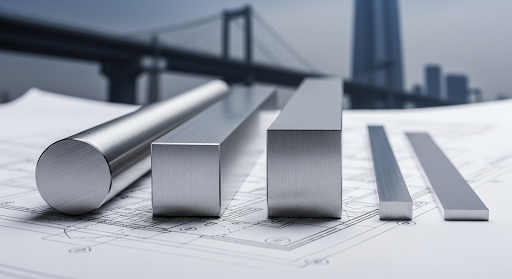
Some materials arrive with fanfare. The aluminum bar usually does not. It tends to sit in racks, stacked in long clean lines, waiting for a machinist, fabricator, or engineer to decide what it will become. Yet that plain start is misleading, because a single aluminum bar can end up as a shaft in a robotic arm, a brace in a curtain wall, or a support inside a vehicle chassis, carrying far more responsibility than its modest appearance suggests.
Over the years, that quiet usefulness has made aluminum bar stock a remarkably effective choice across manufacturing and construction. Buyers are rarely drawn to it for romance. They are drawn to it because it is lightweight, corrosion-resistant, highly efficient in fabrication, and, when the right alloy is chosen, extremely reliable under pressure. That combination has given aluminum an unusually secure place in factories, shipyards, machine shops, and building projects.
An aluminum bar is, at its simplest, a solid length of aluminum alloy with a uniform cross-section. Unlike tubes or pipes, it is not hollow. That difference matters. It gives the bar greater rigidity and makes it particularly beneficial in parts that need strength, stability, or precise machining. Production usually involves extrusion, rolling, or drawing, each method shaping the final surface, tolerance, and performance in subtle but important ways.
The first decision most buyers face is shape. That sounds basic, but it often decides whether the material behaves beautifully in service or becomes an expensive compromise.
Round bars are the most familiar and, in many shops, the most frequently handled. Their circular form distributes stress evenly and suits parts that spin, pivot, or slide into bearings. For shafts, axles, rollers, dowel pins, and custom-machined components, round bars are often the natural choice. In automotive and aerospace work, they have proved incredibly versatile, especially where designers want weight kept low without surrendering strength.
By using alloys such as 6061, round bars can deliver a balanced mix of machinability and corrosion resistance. By shifting to 7075, manufacturers gain significantly higher strength, which is why high-stress components in aircraft and performance equipment often begin as a round aluminum bar. The trade-off, as buyers learn sooner rather than later, is that stronger alloys can ask for more care in finishing and corrosion protection.
Flat bars move in a different direction. Wider than they are thick, they provide a broad working surface and a straightforward profile that fabricators appreciate almost immediately. In construction, flat bars are used for bracing, supports, trim pieces, and reinforcement. In electrical applications, they can serve as conductors or busbars, carrying current with notably improved efficiency while still resisting corrosion.
For architects and builders, flat bars can be particularly innovative in appearance as well as function. They are easily cut, drilled, bent, and welded, which makes them a practical fit for visible components such as door frames, decorative edging, and curtain wall details. On a jobsite, that kind of simplicity can feel like a small mercy.
Square bars have a different personality. They are direct, stable, and unusually cooperative when a design needs right angles and uniform dimensions. Their shape makes them easy to clamp, align, and join, qualities that matter on crowded fabrication benches where precision can slip by a few frustrating millimeters. Square bars are widely used in machinery frames, greenhouse structures, supports, shelving, and even modern furniture where clean lines do much of the visual work.
For structural framing, square profiles are exceptionally durable and strikingly practical. They resist bending from several directions and offer a tidy geometry that simplifies assembly. In workshops producing fixtures or machine bases, that predictability saves time, and time, as anyone on a production schedule knows, has a way of becoming money.
Hexagonal bars are less visible to the casual eye, but they are important in applications where grip and machinability matter. Their six-sided form makes them ideal for fasteners, bolts, and threaded parts. Tools can hold them securely, and that secure hold can lead to more accurate machining, less slippage, and fewer wasted pieces. In sectors where tolerances are tight, that advantage becomes surprisingly valuable.
T-shaped bars serve still another purpose, combining a vertical stem and horizontal flange into a profile designed for support and load distribution. In architectural systems, they can act as support beams. In vehicles, they can contribute to frame design. In electronics, the same shape can help dissipate heat, functioning as a simple but highly efficient heat sink.
Shape, though, tells only part of the story. Alloy selection is where the conversation usually becomes more serious.
6061 remains the dependable favorite for many engineers and buyers. It offers a well-judged balance of strength, weldability, corrosion resistance, and machinability. In practical terms, that means it works across a wide range of applications without demanding too many special concessions. Structural parts, automotive components, machine elements, and general fabrication jobs often return to 6061 because it is simply hard to regret choosing it.
6063 is softer in reputation and smoother in finish. It is often associated with architectural use because it extrudes cleanly and responds exceptionally well to anodizing. For railings, window frames, trims, and decorative structural elements, 6063 gives designers a cleaner visual result while still holding up reliably in outdoor conditions.
7075 changes the tone entirely. This is the alloy engineers reach for when strength becomes the first line in the brief. Used widely in aerospace and defense applications, it can approach the strength of some steels while remaining far lighter. That advantage is remarkably effective in aircraft structures, performance machinery, and other demanding uses where weight reduction is closely tied to performance.
5083 is favored for harsher settings, especially marine ones. Saltwater has a way of exposing weak material choices with embarrassing speed, and 5083 has earned respect because it resists that punishment so well. Ship components, offshore assemblies, and marine hardware often rely on it precisely because failure in those environments is not merely inconvenient; it is costly and, sometimes, dangerous.
I have always found it faintly impressive that a material can look so ordinary on a rack and still end up carrying such specialized demands.
In recent years, manufacturing methods have notably improved the performance of aluminum bars. Precision extrusion, refined heat treatment, and controlled grinding now allow bars to meet tighter tolerances and smoother finishes than many buyers once expected as standard. For aerospace controls, medical devices, and advanced robotics, precision-ground bars can deliver exceptionally clear gains in straightness, diameter consistency, and surface quality.
Those gains matter because tolerance is not a technical footnote. It directly affects scrap rates, assembly time, and long-term wear. A standard extruded bar may work perfectly for general fabrication. A precision-ground bar, though more expensive, can be particularly beneficial when parts must move smoothly, align cleanly, or fit without repeated correction on the shop floor.
Cost, naturally, enters every discussion. Alloy type, shape, size, surface finish, and tolerance all influence price. A general-purpose 6061 bar is usually more affordable than a high-strength 7075 option. A mill finish costs less than a precision-ground or anodized finish. Bulk orders can soften the numbers, while custom sizes often push them upward. None of that is surprising. What can be surprising is how quickly the cheapest option becomes the costliest one when it is poorly matched to the job.
That is why the best buying decisions usually start with application, not price. For machining, 6061 round or square bars are often a safe and highly efficient choice. For architectural framing and visual detail, 6063 earns its popularity honestly. For high-stress equipment, 7075 stands out. For corrosive marine settings, 5083 remains the sensible answer.
Companies such as Conglin Aluminum Technology have benefited from this growing specialization, offering buyers more targeted combinations of shape, alloy, and finish rather than treating every aluminum bar as interchangeable stock. That shift feels optimistic for the industry, because it suggests a more informed market, one where performance and material fit matter more than habit.
And that may be the simplest truth here. The aluminum bar is not merely a piece of metal waiting to be cut. It is a carefully chosen starting point, shaped by application, refined by alloy, and trusted because it keeps proving, again and again, that practical materials often do the heaviest lifting.