A fire risk assessment dated eleven months ago can already be worthless, and on a production site, it very often is.
No law in England or Wales names twelve months as the interval. The Regulatory Reform (Fire Safety) Order 2005 requires that the assessment be reviewed regularly and kept up to date, and that it be revised when the premises change in any way that renders the old version incorrect.
A factory changes constantly, and that’s the whole problem, because a fire assessment should ideally change with it.
Where the Twelve-Month Idea Came from
Article 9 of the Order requires the responsible person to review the assessment regularly, and to revise it if there’s reason to suspect it’s no longer valid or if there’s been a significant change to the matters it covers. Insurers ask for something dated within the last year.
Scotland is governed by the Fire (Scotland) Act 2005 with much the same expectations, and Northern Ireland by its own 2006 Order. None of them specifies an interval either.
So a plant can have a valid certificate dated eleven months ago and still be operating outside the law, because in month three, somebody installed a mezzanine.
Manufacturing Changes Faster Than Almost Any Other Setting
Racking gets extended a couple of bays into an aisle that used to be a clear route to a final exit, and since nobody making that call is thinking about fire, it goes unrecorded anywhere. When a new production line arrives, the load on a distribution board specified years earlier for something smaller doubles, and the contractor who runs cable through a compartment wall to feed it will fill the hole afterwards with expanding foam, which does nothing whatsoever for the sixty minutes of resistance that wall was made to provide.
Mezzanine floors are the big ones, and they go up in flames quickly without anyone recalculating escape routes. Approved Document B allows around 45 metres for a normal-hazard industrial space where escape is possible in more than one direction, and less where there’s only one way out.
Then there’s stock. Peak season arrives, pallets go where pallets have never gone before, and the sprinkler heads that need 500mm of clearance below them are suddenly buried under shrink wrap.
Batteries, Dust and Combustibles
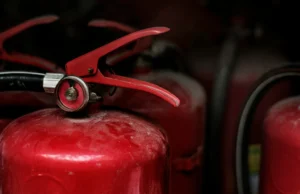
Lithium-ion is changing the risk picture in warehouses and production areas faster than most assessments have caught up with. A plant that swapped lead-acid forklift batteries for lithium-ion has a different fire on its hands, one that reignites, produces flammable gas and doesn’t respond to the extinguishers hanging on the wall.
Combustible dust deserves the same attention. Wood, flour, sugar, aluminium and plenty of other process residues will support an explosion at the right concentration, and DSEAR 2002 applies alongside the Fire Safety Order. Dust that has built up on roof steels and cable trays since the last assessment constitutes a change in the premises, even though no one put it there.
Businesses like Combat Fire deal with this sort of thing constantly, where a plant has made a sensible operational decision that nobody thought to route past the fire risk assessment.
What an Out-of-Date Assessment Looks Like When It Fails
Inspectors from the fire and rescue authority don’t need a fire to happen. They arrive, they walk the floor, and they compare what’s in front of them with what’s written down.
The insurance side moves quietly and hurts later. Policies include conditions regarding material changes to the risk, and a claim is examined against what the insurer was told at renewal.
How Often, Then?
Twice a year, as a baseline for a working production site, with a full reassessment whenever something genuinely changes. Not a review in the sense of signing the front page, but a proper walk of the building with the document in hand.
The triggers worth writing into a site’s own procedure:
- Any new plant or process
- A change to a raw material or its storage
- Building work touching compartment walls or service penetrations
- Change to occupancy or working patterns
- A near miss involving heat or smoke
- A fire door that’s been replaced or repaired.
Most plants already have a change control process for machinery and for health and safety generally. Adding a line to it asking whether the fire risk assessment needs revisiting costs nothing compared to the lives it could save.