
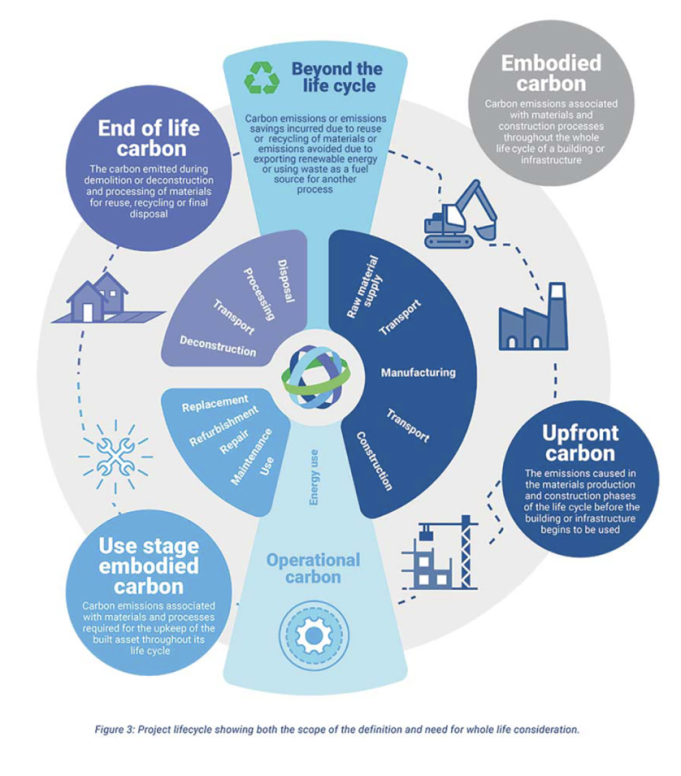
Walk into any modern office, school, or apartment building, and the buzz of everyday life is invisible yet profound. Lights flick on with motion sensors, thermostats quietly adjust room temperatures, and computers hum across desks. Each action seems mundane, but collectively they leave a hidden mark: operational carbon. In the UK, this is increasingly recognised as the elephant in the room of energy efficiency buildings, quietly accounting for the largest share of a structure’s lifetime emissions.
Operational carbon is different from the emissions involved in constructing a building. It’s about what happens after the doors open, day after day, year after year. Heating the radiators in winter, cooling offices in summer, keeping fridges humming, charging laptops—every kilowatt-hour consumed releases CO₂. In older buildings, inefficiencies can multiply this impact. Draughty windows, ageing boilers, poorly insulated walls, all become invisible culprits. The result is a carbon footprint that quietly grows, often unnoticed by those inside.
The UK has set ambitious targets for net-zero by 2050, and buildings sit at the heart of that agenda. Operational carbon reduction is not just a technical exercise; it is a social and economic challenge. Energy-efficient buildings, from retrofitted Victorian terraces to sleek new commercial complexes, are emerging as testbeds for innovation. Smart meters, heat pumps, LED lighting, and even the way windows are positioned can make measurable differences. Policymakers are leaning on standards like the Building Regulations Part L to push the sector forward, but adoption is uneven, and progress sometimes feels slower than headlines suggest.
I remember visiting a small London school, its heating system barely audible, yet an energy dashboard on the wall revealed an hourly tally of emissions that seemed to spike in surprising ways. It struck me how operational carbon is both predictable and mysterious, a daily footprint that can be tracked yet often escapes conscious thought. Teachers, students, and staff were making choices that had no obvious carbon consequence, yet their combined impact was clear.
The conversation often narrows to energy efficiency, but operational carbon cannot be solved with insulation alone. Occupancy patterns, appliance use, and even simple behaviours—turning off a light or leaving a window open—contribute meaningfully. Analysts now focus on predictive energy modelling, simulating how a building will perform over decades. These projections guide design choices, from glazing ratios that balance heat gain and loss, to automated ventilation systems that reduce unnecessary heating or cooling. Every decision, seemingly small, accumulates in the carbon ledger.
Commercial property managers in the UK are increasingly aware that operational carbon is financially material. Energy costs rise, tenant expectations evolve, and regulatory pressures mount. For many, reporting emissions is no longer optional; it is a component of market positioning. Green leases and sustainability-linked financing now tie investment returns to demonstrable reductions in operational carbon. In practical terms, this has prompted upgrades to heating systems, lighting, and building management systems, sometimes accompanied by staff training to reduce unnecessary energy consumption.
Even residential buildings are under scrutiny. The UK’s EPC (Energy Performance Certificate) framework makes operational efficiency visible to prospective buyers and renters. Homes with better scores tend to command higher interest, both economically and environmentally. Yet the challenge is considerable: much of the housing stock predates modern energy codes. Retrofitting thousands of homes with heat pumps, insulation, or solar arrays requires coordination, funding, and patience. Policymakers debate incentives and regulations, but the lived reality is often slow, incremental, and patchy.
Operational carbon also reveals broader societal questions. Who bears the responsibility for emissions when multiple households share the same building? How do we balance comfort, convenience, and carbon reduction without alienating occupants? In offices, schools, and hospitals, human factors complicate the clean engineering solution. People turn up the heat, leave devices plugged in, and open windows, sometimes instinctively, sometimes unconsciously. Reducing operational carbon is as much about culture as it is about technology.
The conversation around energy efficiency buildings often focuses on flashy solutions: net-zero developments, green roofs, or high-tech façades. Yet it is the cumulative, quiet impact of everyday choices that shapes operational carbon most. In this sense, a building is not just bricks and glass; it is an ecosystem of habits, design decisions, and energy flows. Monitoring and nudging those flows can cut emissions significantly without dramatic architectural interventions.
As the UK pushes towards a decarbonised building sector, operational carbon explained UK-style demands both pragmatism and imagination. Retrofitting older structures, adopting low-carbon heating, installing smart controls, and fostering mindful occupant behaviour—these measures together form a mosaic of possible solutions. It is rarely glamorous, often invisible, but essential. Every switch flipped, every radiator adjusted, every kilowatt-hour saved matters.
Operational carbon is the daily reminder that climate action is not only about grand gestures or headline-grabbing projects. It is also the quiet arithmetic of energy in the spaces we inhabit. It asks us to see buildings not as static objects but as ongoing processes, and it forces a reckoning with the habits we take for granted. In this, there is both challenge and opportunity: the more we understand it, the more we can shape it.