
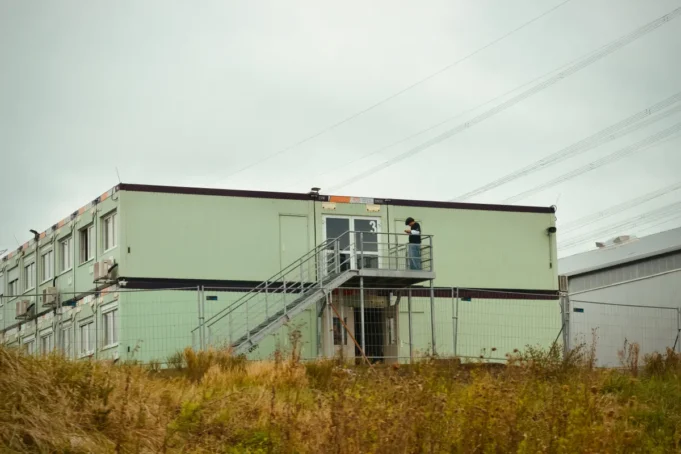
Portakabin‘s Darwin Group healthcare strategy has been fundamentally redrawn following a difficult year in which complex, large-scale modular healthcare builds generated cost overruns that cut the wider group’s pre-tax profit to £9.6m, down from £37.2m in 2024, according to newly published accounts for the year to 31 December 2025.
Group turnover fell to £516m from £619m in the prior 12 months, with the Darwin Group subsidiary accounting for a substantial part of that decline. Darwin Group’s own turnover almost halved to £71.8m from £139.9m, and the subsidiary recorded a pre-tax loss of £3.1m, compared with a profit of £9.2m in the previous year.
What went wrong with Darwin Group’s healthcare contracts
The accounts state that during the year Darwin Group delivered “a number of large, permanent” modular facilities for UK healthcare providers. “Some of the contracts delivered in the year were complex and ran into operational delivery challenges, which resulted in cost overruns and affected financial performance,” the accounts said. The specific facilities were not named.
The difficulties illustrate a recurring challenge in offsite construction at scale: the promise of factory-controlled quality and compressed programmes can erode quickly when bespoke, large-footprint healthcare buildings encounter site-integration complexity, supply-chain sequencing and client-change pressures that smaller modular units rarely face. The Darwin Group healthcare strategy reset is a direct response to those realities.
Portakabin acquired Darwin Group in 2023. At the time of that acquisition, Construction Wave reported that the business had around 200 employees and turnover of £80 million in 2022, making the subsequent near-halving of revenues to £71.8m in 2025 a further contraction from what was already a smaller base than the acquisition year suggested. According to CB Insights, Darwin Group was founded in 2006 and is based in Shawbury, England, giving it close to two decades of offsite healthcare specialism before the Portakabin deal.
Darwin Group healthcare strategy pivots to smaller, less complex schemes
The strategic response is clear and specific. Darwin Group has committed to selling only “smaller, less complex, modular” healthcare-build facilities going forward, while continuing to supply modular units to the healthcare sector on a hire basis. The shift effectively repositions the subsidiary away from the high-risk, high-value permanent-build segment where the cost overruns occurred, and towards volume-driven, repeatable product lines where programme predictability is more defensible.
For procurement teams and NHS estates managers, the practical implication is that Darwin Group will no longer be tendering for the large permanent modular healthcare facilities it previously pursued. That segment of the market, which carries both the highest embodied-carbon reduction potential at scale and the greatest delivery risk in complex clinical environments, will now be contested by fewer offsite specialists capable of executing at that size.
The wider Portakabin group sought to frame the overall picture more positively, stressing a “strong underlying adjusted” performance and pointing to net cash of £31.8m at the year end, having invested £153m in its hire fleet during the period. Net cash had stood at £42.3m at the end of 2024. Employee numbers edged up to 2,246 from 2,220, though the wages bill fell to £110.6m from £112.7m.
Beyond healthcare, Portakabin maintained a presence in the education sector. In 2025/26 it was ranked among the Department for Education’s highest-paid construction contractors, winning £21.7m of contracts, and it was placed 36th in the latest CN100.
Looking ahead, the group stated it “will continue its growth ambition across the UK and Europe with further investment in fleet and infrastructure,” with the hire business identified as the primary growth engine, executed through “tailored go-to-market strategies in each of its target regions and end markets.” The hire-first orientation, less exposed to the bespoke delivery risk that undermined Darwin Group’s permanent healthcare builds, is now clearly the structural priority across the group.