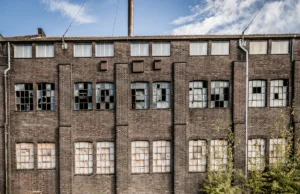
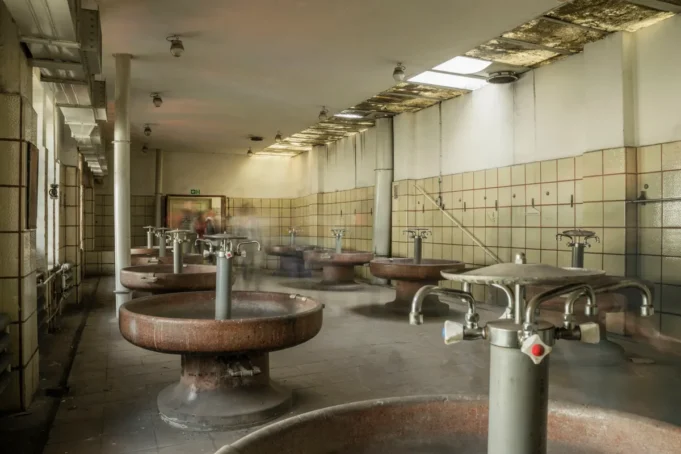
Four shortlisted teams have published their Ladywell Playtower regeneration concepts for the Grade II-listed Gothic Revival bath house in south-east London, as Lewisham Council opens public consultation on which partnership should lead the complex heritage restoration of the building, abandoned for more than 20 years.
The Playtower was constructed in 1884 to designs by Wilson, Son and Aldwinckle, originally operating as Ladywell Baths with pool halls, slipper baths and function rooms. It later served as a community centre and playgroup before suffering fire damage in 2006. The 140-year-old structure sits within the St Mary’s Conservation Area and, given its listed status, any restoration will need to balance heritage integrity with financial viability and long-term community operation.
Four teams, four approaches to a difficult brief
The council launched its search for a partner organisation in January, specifying experience in complex heritage restoration and community-facing operations. The four shortlisted teams each approach the brief from a distinct direction.
Turner Works proposes working in an ‘architect-plus’ role, taking on both design and operational management of the restoration. Led by what the practice describes as a proud Lewisham local, Turner Works plans to establish a staffed project hub in the former Mortuary building adjacent to the Playtower from the outset, activating the site with local markets, exhibitions and performances while the main restoration is being planned. The concept draws explicitly on the practice’s experience operating ‘meanwhile’ spaces, and cites the Horniman Museum as a model: combining London-wide draw with a hyper-local community heart.
Liquid Listening, working with heritage consultancy Purcell, proposes an arts and wellbeing hub that also brings the adjacent Coroners Court and Mortuary within its scope. Their concept centres on water-based wellbeing, referencing the site’s original hydrological heritage and the historic Ladywell itself. The design would expose and restore key architectural features including the tower, chimney, vaulted ceiling, galleries and original brickwork and stonework, with new wellness interventions adopting the circular form of the original well.
The Rural Urban Synthesis Society (RUSS) with south London-based Latitude Architects takes a mixed-use approach. Their proposal includes a café, affordable studios and workspaces, and the former Bathing Hall converted into a flexible performance and events space. A flagship LEYF nursery and Early Years Training Academy would provide places for more than 100 children and support around 100 apprentices at any one time. Above the nursery, 11 affordable homes for older people would anchor an intergenerational programme. RUSS plans to bring the Coroner’s Court, Mortuary and grounds into use within the first year through interim health, wellbeing and creative activities.
Hackitt CIC frames its concept around displacement and belonging, positioning the Playtower as a community anchor for residents who feel pushed out by rising rents and diminishing local services. Their vision centres on accessible hydrotherapy and spa facilities designed around privacy, dignity and calm, alongside wellbeing, skills and creative provision.
Ladywell Playtower regeneration concepts follow a cancelled scheme
The current process follows the termination of an earlier agreement with Bromley-based developer Guildmore, which had partnered with Maccreanor Lavington and Pringle Richards Sharratt on a scheme to convert the bath house into a cinema and housing. Lewisham Council cancelled that arrangement before the current open-partner approach was initiated.
The council itself changed hands at last May’s local elections, shifting from Labour to a Green-run administration. Councillor Daniel Dream, cabinet member for inclusive regeneration, planning and housing delivery, described the Playtower as having “incredible potential” and said the building had “stood empty for far too long.” Dream stated that the council was “determined to move forward at pace, while making sure we find the right partner to restore the building, protect its heritage and create a future we can all be proud of.”
The council’s stated criteria for selecting a partner are that any proposal be deliverable, financially viable and shaped by local priorities, a framing that implicitly acknowledges the difficulties that have beset previous attempts to activate the listed structure. Heritage restoration of this complexity, particularly on a building with basement infrastructure and significant fabric deterioration following years of vacancy and fire damage, carries both high upfront capital requirements and ongoing operational risk.
Community consultation runs until Monday 16 November, with residents asked to complete an online survey on the four proposals. A public drop-in event with the shortlisted teams is scheduled for Thursday 15 October, from 3pm to 8pm, at St Mary’s Centre, Ladywell Road, where residents can engage directly with the competing visions before the council moves to appoint a preferred partner.